Use of AI in business in Warwickshire
A Prime Accountants survey has revealed more than half of Warwickshire businesses who responded have reservations around the use of AI in business.
By Morgan Davies
Business owners in Warwickshire fear implementing AI technology due to a lack of knowledge about how they should use it, a new survey we commissioned has revealed.
Insights gathered from a survey of 126 county firms give a view of the appetite for using AI and, crucially, some of the main barriers which are preventing businesses from using it.
The study, commissioned by ourselves and Coventry and Warwickshire Chamber of Commerce, revealed that 54 per cent of respondents – all of which are Chamber members – had introduced AI in some aspect of their day-to-day operations.
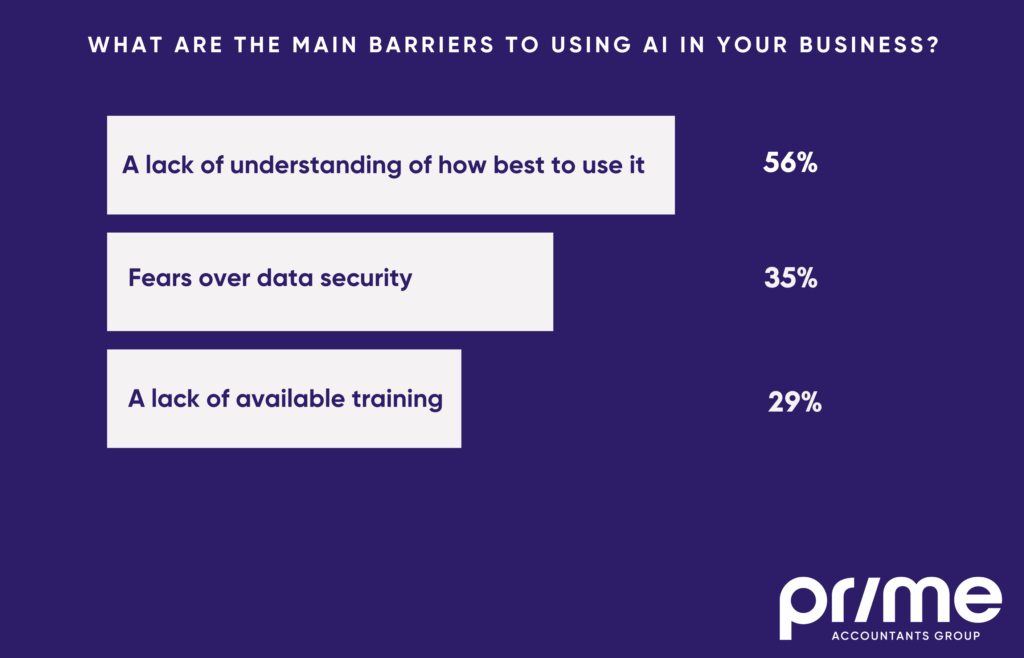
However, 70 firms – 56 per cent – said one of the main barriers to accessing the full benefits of AI in business was a lack of understanding of how best to use it, while 44 businesses – 35 per cent – cited a lack of available training to learn how to use AI.
For 29 per cent of respondents – 37 businesses – data security was a key reason for not using the technology.
Warwickshire firms reluctant to use AI due to ‘lack of knowledge’
- Our survey of 126 Warwickshire businesses found more than half have introduced AI in some way
- But 56 per cent of those surveyed said they had reservations based on not understanding how best to use it
- 1 in 5 said they would consider using AI for payroll and 1 in 4 would consider using it for accounting
The research has revealed how polarised views can be on the advantages and disadvantages of AI in business such an early point in the technology’s development.
There’s not a one-size-fits-all approach. There’s some who see use of AI in business as the way to get a competitive edge, then there’s a middle ground who are fearful that if they don’t do something, they’ll get overtaken.
Then there’s the extreme final view, which is ‘over my dead body’ – they won’t go near the technology at all.
However, the facts of life are that businesses must always change, and that change needs to be in the right direction and future-focused. We haven’t got a crystal ball, but I feel that those who reject AI entirely will end up being less successful in the long run.
Automation a strong pull factor for using AI applications in business
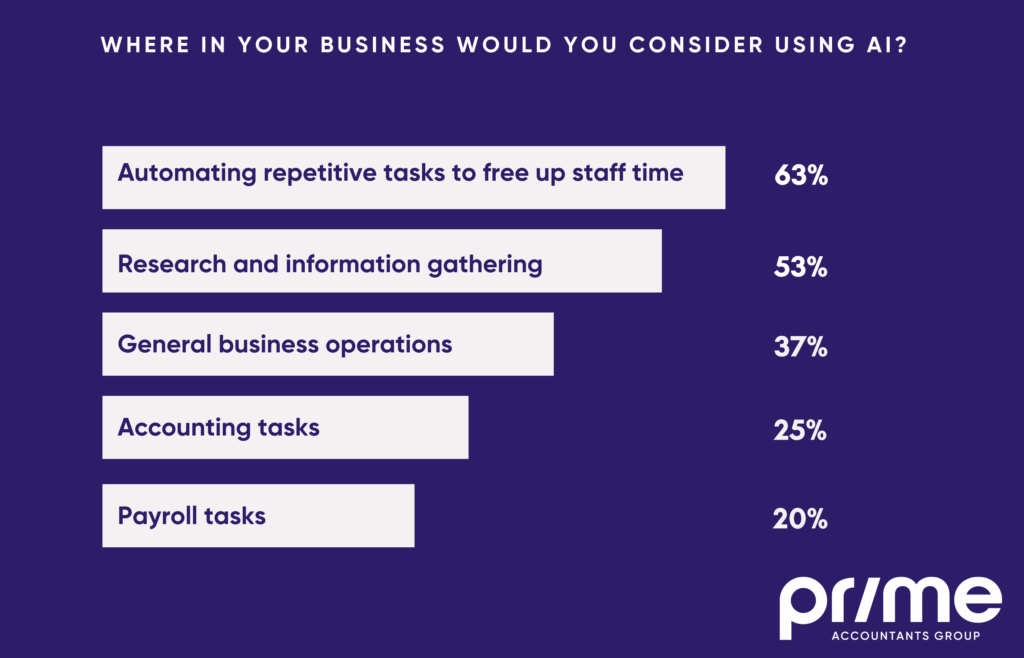
The study revealed automation was a positive benefit of AI, with 63 per cent of business owners surveyed saying that automating repetitive tasks to free up staff time was one of the main opportunities AI presented.
In addition, 53 per cent said one of the main opportunities it presented was speeding up research and collation of information.
It’s why learning how to use AI effectively is the biggest improvement businesses could make.
If you can take a job that’s inefficient or repetitive and automate it, then it can be extremely valuable – but unless you know how to use AI effectively, you’re not going to get the best from it.
You’re going to sleepwalk into some potential risks. For example, with some of the free AI software, your private data could go off outside of the country and you could be breaching GDPR rules.
The biggest barrier to learning is, where do you find this information from?
When you think about learnings we have in our careers, we tend to have been taught them with books, lectures and training courses. If you’re asking yourself “how can I learn to use AI” the answer is not always obvious.
With AI, the technology can immediately do a percentage of my job overnight – but we’re not taught how to use it in a safe, effective way and therefore we don’t know what the risks are.
Using AI in payroll, accounting and HR
The survey also revealed attitudes towards automating tasks which have historically been trusted to professionals, including payroll, HR, operations and accounting.
One in five respondents said they would consider using AI in payroll and one in four for accounting – however, 28 per cent said they wouldn’t use it in any of these areas.
A total of 37 per cent said they would consider it for operations, 25 per cent for accounting and 20 per cent for payroll, while 16 per cent said they would see the benefits of AI in HR.
These results show we’ve come full circle. When I was starting out in accounting in the 90s, we started with pen and paper and calculators and then moved to laptops and Excel. We realised how we could automate tasks using Excel and become more efficient.
So, if businesses are considering these changes, most that I speak to have to start with their infrastructure. There’s a transition with using AI in accounting software – moving your IT infrastructure to the cloud makes it easier for AI tools to access the data you want it to.
If it’s on your own network it can often be harder to do because it’s closed, and that transition is difficult. You need to understand what you’re doing and the cybersecurity risks.
I think business owners need to invest in IT training for their teams, particularly for their leaders to start with. If the leaders are aware of the opportunities, they can help their team learn how to use AI effectively, which drives their team’s development and their use of AI in a particular direction.
How can I learn to use AI in business?
If you need advice on the the impact of AI in business, or our experience of using AI in accounting software, then get in touch.